


What is Accounts Payable?
Accounts payable refers to the unpaid bills your business owes to suppliers, vendors, or service providers. The moment you receive goods or services from third parties, but haven’t paid for them yet, then such amount becomes your accounts payable. This means you are obliged to pay them the agreed amount within the specified payment period.
How to Organize Accounts Payable? [8 Best Practices]

Here are 8 best practices to master the accounts payable organization in your business.
1. Standardize Procurement Flow
Having a structured procurement process in place plays a huge role in organizing accounts payable. Ask yourself, how do you manage the current procurement process? In case you fail to answer it in one go, you likely need a more consistent procurement process than you think.
This is because errors occur in the AP process when you don’t have standard procedures for acquiring goods and services. Therefore, discuss with your team and list out clear procurement steps, from raising purchase requests to receiving goods and paying vendor invoices.
2. Optimize AP Workflows
Already have a streamlined procurement flow? Next, focus on optimizing AP workflows in a way that every invoice follows a pre-defined path and glitch-free payment processing. Since you are at the helm of your business, buy some time and define hierarchies for invoice approval and processing that everyone follows. The optimized workflows not only improve invoicing processing but also result in lasting relationships with vendors.
3. Automate Where Necessary
Free yourself from the daily grind by automating what keeps you and your team busy. Automating manual entries and lengthy calculations is standard practice for modern businesses to get rid of repetitive tasks.
Assess the areas where you usually spend more time, like frequent manual data entry or payment calculations. Thereafter, get a sophisticated tool that adapts to your needs and automates such things without compromising accuracy. In case you don’t require a fully automated process, opt for partial AP automation.
4. Introduce Self-service Portals
Provide a self-service vendor portal to lessen manual dependencies, especially when it comes to taking manual follow-ups. Vendors can manage their invoices, view payment status, and even connect with the AP team if they have any concerns. Such things boost transparency while reducing overall administrative workload.
For example, a business can switch to Moon Invoice’s dedicated vendor portal to organize multiple vendor invoices. A self-service portal where one can track recent activities, see statements, and keep a close eye on cash movements.
5. Define Team Roles
Have a team to handle the AP process? Start assigning roles and responsibilities to each member. Define who will take the ownership of invoices, approvals, or payments and eradicate delays. When everyone knows their role, accountability improves, approvals are faster, and communication gaps narrow, laying the foundation for an organized accounts payable process.
After all, assigning team roles is not only for settling unpaid invoices, but also for better internal controls. Failing to define these roles will lead to disorganization in the AP cycle and can quickly spiral things out of control.
6. Invest in Accounting Tools
Harness accounting tools or software to organize accounts payable with unparalleled automation. Automated software comprises features like automatic reminders, real-time updates, and frictionless reporting to make sure you stay on top of accounts payable.
That’s probably why we see more businesses migrating to advanced accounting software rather than juggling Google Spreadsheets. When you invest in the right tools or software, you bypass unnecessary errors and no longer stay up late fixing them.
7. Keep Tracking AP Metrics
Whether you do it on your own or utilize automated software, don’t forget to count on the main accounts payable metrics. They play a central role in revealing accuracy, error rates, and bottlenecks as well. AP metrics are instrumental in every accounting practice, benefiting businesses in organizing the entire AP process.
Days Payable Outstanding (DPO), invoice processing time, and exception rate are a few metrics to track regularly in order to manage the AP process efficiently. Such practices are standard across all business sizes because they provide full visibility into cash flows.
8. Ensure Accounts Reconciliation
Reviewing and reconciling your bank accounts may not be something that excites your team, but it is more important than you think. Instruct your accounts payable department to compare the accounts payable sheet with the bank statement on a monthly or quarterly basis. This practice ensures that every payment is successfully matched against the corresponding invoice.
If the volume of accounts payable invoices is higher than usual, consider the accounts payable filing system, where you can reconcile data within a few seconds. Professional accounting software is a boon for AP teams, helping them identify duplicate payments in less time and effort.
Small Mistakes Can Cost Big Money
Don’t let small mistakes snowball into costly losses. Automate bank reconciliation with Moon Invoice and free yourself from the data-entry marathon.
Challenges in Managing Accounts Payable
Overseeing accounts payable always comes with risks and challenges, especially if you are handling it manually. Let us discuss some of them.
- Manual Follow-ups: The AP team needs to call suppliers frequently or even meet them in person to fill in the missing information. Sometimes they need to follow up for months.
- Processing Delays: Even minor errors found while invoice matching can lead to longer than usual delays, which may eventually drain supplier or vendor relationships.
- Compliance: Complying with state regulations will be a formidable challenge when you prefer entering invoice data manually. It gets even more complicated if your region enforces e-invoicing rules.
- No Cash Flow Visibility: Complete lack of visibility into payment discrepancies, missed early payment discounts, and cash flow, undermining the business owner’s confidence to make decisions.
- Fraud Risk: Growing risks of fraud attempts and even internal fraud loom over the AP process unless you have advanced accounting tools with bank-grade security.
Why Is Organizing Accounts Payable Important?
A few aspects why one should never overlook managing accounts payable in their business.
- Financial Control: Taking care of the entire AP process will reward you with better financial control, allowing you to decide what’s best for your business.
- Long-term Vendor Relationships: Handling accounts payable with automation ensures timely payments and builds long-lasting relationships with your vendors.
- Security: A well-organized accounts process will keep fraudsters at bay and prevent data from being exposed to internal or external hackers.
- Audit & Compliance Readiness: Accounts payable, when organized well, keeps reports audit-ready and in compliance with regulations, with no last-minute chaos.
- Strategic Decisions: Managing AP boosts owners’ & CFO’s confidence in making informed decisions about business and investments.
How to Implement AP Automation?
If you have reviewed your current workflows and decided to bring in automation throughout the entire AP process, below is the checklist that you need to follow.
- ✅ Identify how much time your team spends doing manual things.
- ✅ Next, define your goals that align with your vision and improve ROI.
- ✅ Research and finalize an accounting solution that meets your AP requirements.
- ✅ Roll out automation in different phases to your finance, sales, and IT teams.
- ✅ Simultaneously, educate your team to embrace automation via training sessions.
- ✅ Implement the AP automation gradually to other departments as well.
- ✅ Once implemented, keep tracking key metrics to gauge team performance.
How Moon Invoice Helps to Manage Accounts Payable
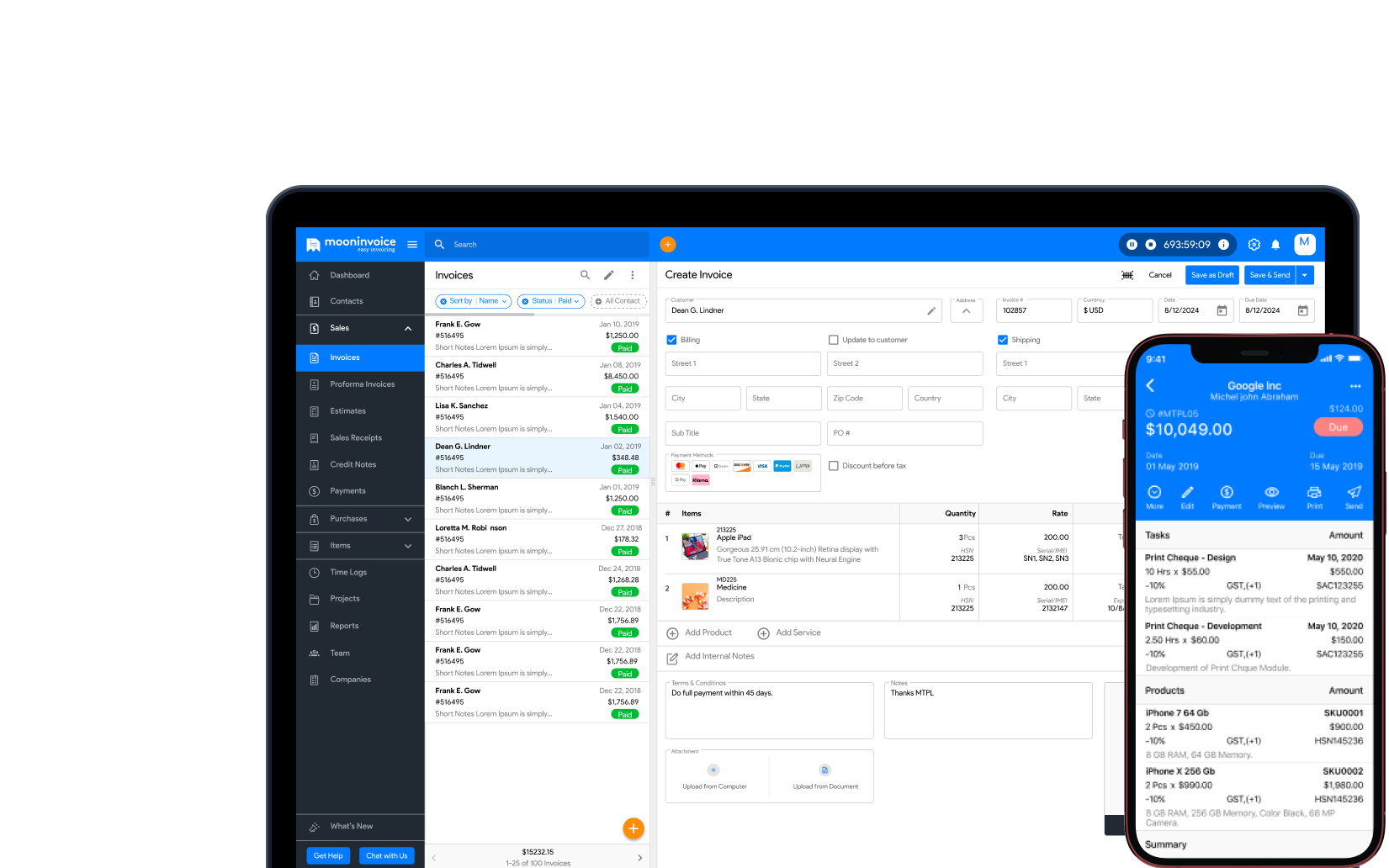
Accounts payable management is a cumbersome task that steals your time. Actually, a lot of time. Moon Invoice, an advanced invoicing software, brings back those lost minutes, eliminates the need to type too fast, and adapts to your needs as your business scales.
With AI at its core, Moon Invoice automates bookkeeping, reconciliation, and payment reminders, so that your AP team does not get burned out.
Plus, no need for doing math or manual calculations to generate accounts payable reports. It auto-generates the reports on one click and gives you complete visibility into cash flow movements. You get high-quality reports that help you confidently make the right decisions.
Here’s what happens when you move past spreadsheets and switch to Moon Invoice:
- 👉 AI automation ensures accuracy in accounts payable data.
- 👉 Keeps reports audit-ready and tax compliant.
- 👉 Less manual dependencies and no time wasted.
- 👉 Frees you up from reviewing AP sheets twice or thrice.
- 👉 No fear of misplacing AP-related documents.
- 👉 Export-friendly reports to assess team performance.
- 👉 Multi-layered security to fight fraudsters.
Manage Accounts Payable Stress-free With Moon Invoice
Adopt Moon Invoice now and relieve your accounting stress.

Auto-calculations
Auto-reminders
Auto-reconciliation
Rounding it Up
When you are in the driver’s seat of your business, organizing accounts payable becomes a significant process. After all, it isn’t about keeping books tidy, but getting a fine grip over cash flows. The AP process also nullifies the strains and lays the foundation for growing vendor or supplier relationships.
No matter whether you take care of the AP process manually or use some automated tool, the goal remains the same, i.e., to reduce payment times, improve accuracy in reports, and gain visibility into cash flow. On that note, we recommend trying Moon Invoice free for a straight 7 days and find out why it is the best bet for your business.
People Also Ask
What is the best way to organize invoices?
How to process accounts payable invoices?
What is the workflow for accounts payable?


Jayanti Katariya is the founder & CEO of Moon Invoice, with over a decade of experience in developing SaaS products and the fintech industry. He holds a degree in engineering. Since 2011, Jayanti's expertise has helped thousands of businesses, from small startups to large enterprises, streamline invoicing, estimation, and accounting operations. His vision is to deliver top-tier financial solutions globally, ensuring efficient financial management for all business owners.